
BALKANS DIGITAL GATEWAY WORKS – BDGW
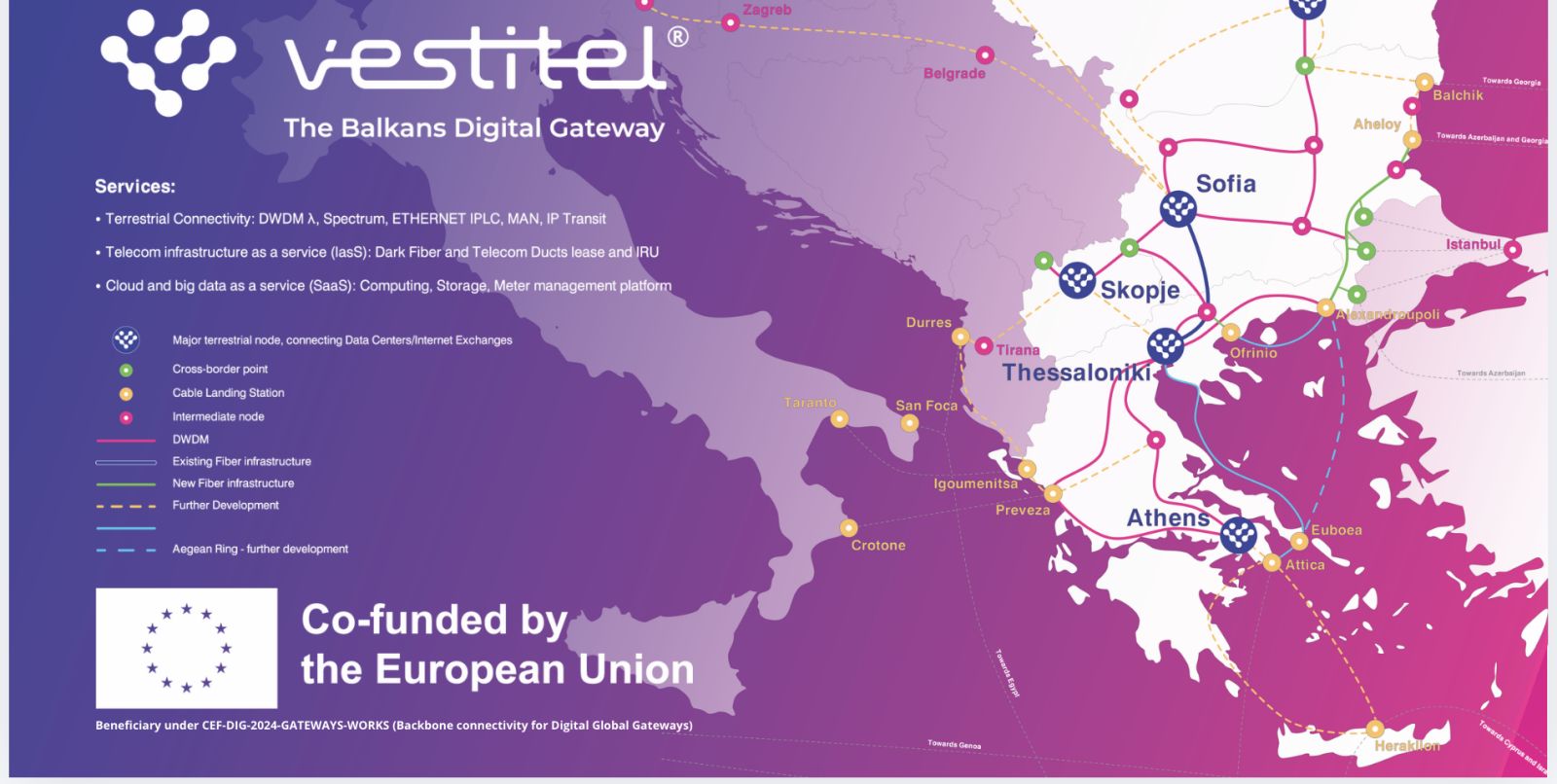
The overall objective of the Balkans Digital Gateway Works (BDGW) project is to establish a high-capacity, resilient fiber optic backbone network across South-East Europe as well as providing possibility for secure routes to third countries (exp. Moldova, Ukraine). This network aims to significantly enhance cross-border communications among key cities in the Balkan region, while also facilitating future submarine connectivity between the Black Sea and the Aegean Sea.
The project is based on preliminary data developed through the project Balkans Digital Gateway Study (BDGS), financed under 101181304 — CEF-DIG-2023-GATEWAYS.
The BDGW project includes two major activities – New Network Deployment and Upgrade of the Existing Network.
1. New Network Deployment – focused on the construction of two fiber optic routes:
The Burgas-Alexandroupolis route traverses Bulgaria and Greece and its strategic design ensures connectivity towards Central Europe via Sofia and extends to Asia and the Middle East through the Black Sea and Istanbul. Equipped with state-of-the-art fiber-optic technology, this route promises high data transfer speeds, low latency, and increased bandwidth, thereby facilitating improved communication and data exchange.
Complementing this is the Ofrinio-Serres route that will connect the existing Sofia-Thessaloniki line to future connectivity points on the Aegean Sea and will ultimately link back to the Burgas-Alexandroupolis line, effectively closing the communication loop in the region.
2. Upgrade of Existing Networks
The activity aims to significantly enhance the telecommunications infrastructure across the Balkans by reconstruction of the Sofia-Thessaloniki route. This upgrade involves the restoration and reconstruction of existing infrastructure, including the replacement of pipes and fiber optic cables between Sofia and Kulata, and between Kulata and Thessaloniki. This upgraded route will also establish interconnection to facilitate seamless data exchange between Bulgaria and Greece, connecting to regional and global networks. This setup will enable seamless data exchange and communication across the region, ultimately contributing to a more interconnected digital landscape in Southeast Europe.
Lastly, the network’s upgrade includes implementation of Dense Wavelength Division Multiplexing (DWDM) system. This technology will enable very-high data transmission capabilities of up to 40 Tb/s per section, with a total capacity reaching 200 Tb/s. The equipment will ensure comprehensive, reliable, and high-speed connectivity between key cities in the Balkan region, as well as facilitating communication between the Black and Aegean Seas.
The BDGW project is a critical response to the growing demand for high-capacity, low-latency, and resilient digital infrastructure in South-East Europe. The current situation in the region reveals significant challenges in terms of digital connectivity, network redundancy, and access to international traffic exchange points. The BDGW project will address:
Capacity and Redundancy Needs – BDGW is designed as a digital getaway, planned to interconnect Romania, Bulgaria and Greece transforming the digital ecosystem in South-East Europe, including EU candidates such as Moldova and Ukraine. The project will create an alternative route for data transmission, reducing the risk of service interruptions caused by natural disasters, cyberattacks, or geopolitical disruptions.
Interconnection needs – The region’s shared connectivity is reflective of its geographical position as a launching point to Africa, the Middle East, and beyond, showcasing the strategic importance of this geographical area in facilitating international communications and expanding network reach.
Data and IXP development needs – Regional IXPs can future-proof the growth potential of South-East Europe by guaranteeing smaller cities and local economy’s prospects by enabling solid broadband infrastructure which supports the way businesses work.
Submarine connectivity needs – Submarine cable infrastructure is a significant element in the broader Internet ecosystem in achieving European digital sovereignty, given that the overwhelming majority of international data traffic is carried through submarine cables.
Project Parametars
- PROJECT NUMBER: 101241081
- PROJECT ACRONYM: 24-EU-DIG-BDGW
- GRANTING AUTHORITY: European Health and Digital Executive Agency (HaDEA)
- CALL: CEF-DIG-2024-GATEWAYS
- TOPIC: CEF-DIG-2024-GATEWAYS-WORKS
- PROJECT BUDGET: 24,000,000 EUR
- EU Funding: 10,101,467 EUR
- PROJECT TIME FRAME: 36 months, commenced December 2025
- PARTICIPANTS LIST:Vestitel BG and Vestitel Hellas
Funded by the European Union. Views and opinions expressed are however those of the author(s) only and do not necessarily reflect those of the European Union or HaDEA. Neither the European Union nor the granting authority can be held responsible for them.